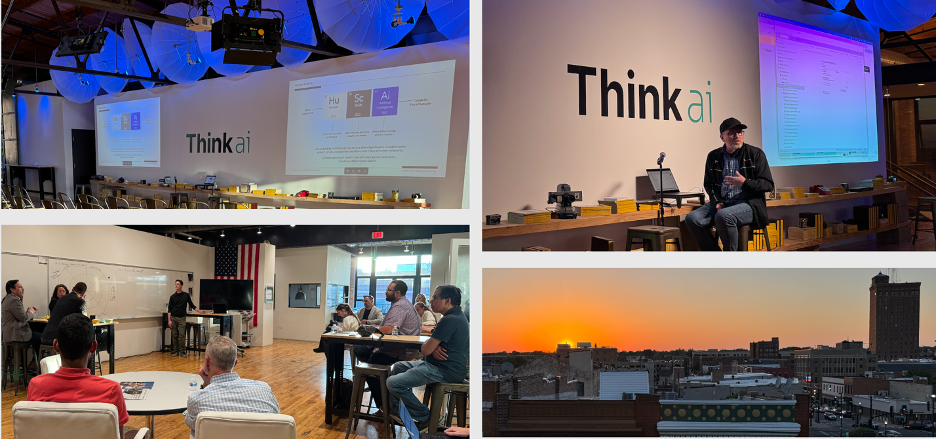
Last week I joined ThinkAI Open House’s evening session, which brought together an interactive workshop led by innovation coach Carmelina Piedra, a hands-on demonstration by Jim Harmon, author of Cloud Code, The Unofficial Guide, and my own facilitation on “making sense in the AI era?”
Here is my facilitation deck covering the present and future of work alongside insights into professional development and the current state of AI adoption, which aligns and validates the mission of Human Scale AI driving the work we have set out to advance.
My talk explored a consequential paradox: as AI systems rapidly improve, organizational clarity and human agency often lag behind expectations. What emerged was not another conversation about tools alone, but a deeper insight into our ways of learning, working, and leading while navigating the uncertainties brought about by an AI‑mediated world.
As Arthur C. Clarke stated, any sufficiently advanced technology is indistinguishable from magic. Ethan Mollick reminds us, “today’s AI is the worst AI you will ever use.” Both statements happen to be a true reflection of the tension defining the current moment.
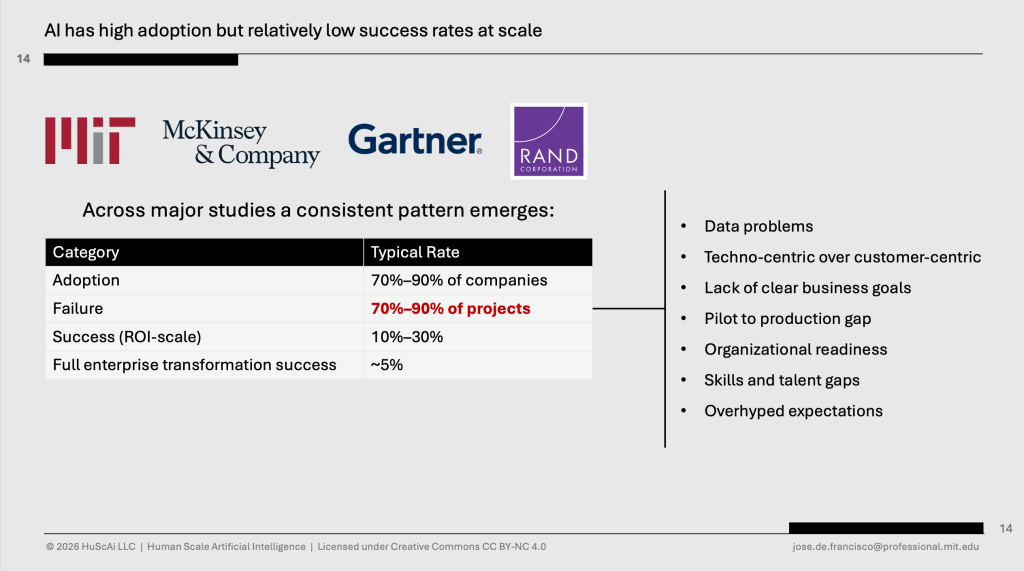
Despite rapid technical progress, most AI implementations are not delivering expected outcomes, with failure rates estimated between 70 and 90 percent, depending on the source. Enterprise successes, however, tend to share a common pattern: they go beyond the technology itself. As findings from the Stanford Digital Economy Lab suggest, success emerges when AI initiatives are grounded in organizational design, leadership intent, and human systems, not tools alone (see pages 14–15 in my deck).
AI adoption is accelerating. Nonetheless, only about 10 percent of the workforce currently uses AI as part of their daily work. At the same time, small and medium sized businesses (SMB) account for roughly four to five out of every ten jobs, and continue to face persistent hiring challenges. In this context, most organizations are not seeking deep technical expertise from entry‑level candidates, but rather foundational skills that enable learning and adaptation to what might be next.
Economic value increasingly shifts toward interdisciplinary roles, and nonlinear career paths become the norm. The future of work favors blended skillsets over narrowly defined expertise. I explore this shift further in my earlier Human Scale Discussion at ThinkAI back in April, where I outline the skillset, mindset, depth, and leadership qualities required to thrive.
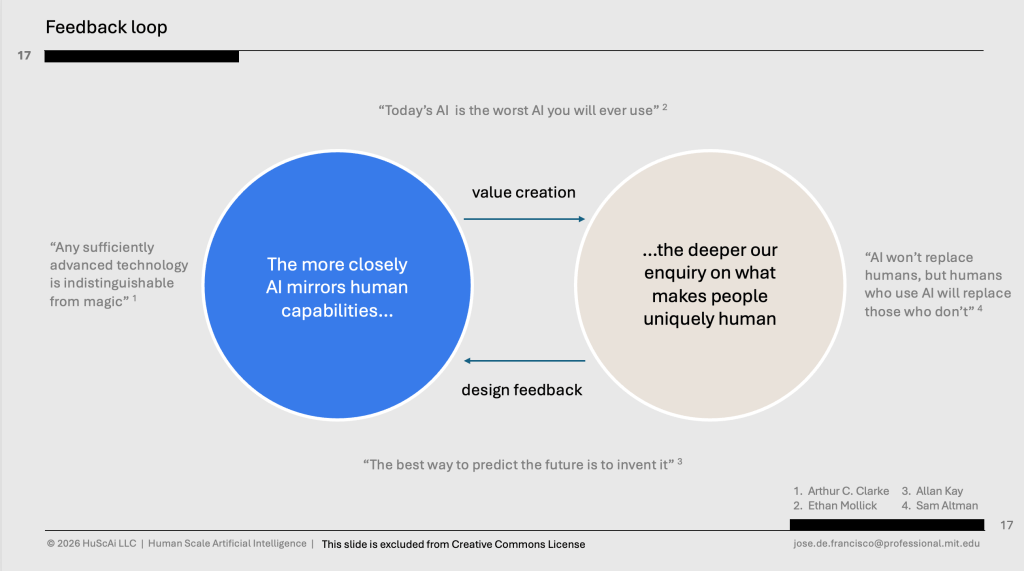
During my session, we explored a defining dynamic of the current AI moment: the closer AI systems come to mirroring human capabilities, the more clearly we are expected to articulate what makes humans distinct, and what it takes to create and deliver value. This feedback loop is central to the progress of human‑centered AI.
As early as the 1950s, Herbert Simon recognized that AI is not simply a technical artifact, but a purposely designed system that reflects human possibilities and constraints, as well as shared values and culture. That insight remains deeply relevant today as AI systems increasingly impact how work is structured and decisions are made.
When AI becomes a substitute for the effort required for us to learn foundational concepts, it can create an illusion of understanding while quietly eroding human agency. Over time, this dynamic increases the risk of systemic breakdowns, which is an issue I examine further in my earlier article, Barcelona’s CHI 2026 (1): AI Singularity.
The conversations at ThinkAI Open House reinforced a central conviction: the future of work will be shaped by the design choices we embed into our systems. Human-centered AI rallies proven success factors. As individuals and organizations navigate uncertainty, the ability to operate at human scale can make all the difference.
I would like to thank Jimi Allen and Kate Allen for their kind invitation to participate in the ThinkAI Open House, as well as everyone who joined the evening sessions.
ThinkAI is a community‑driven think tank that brings together leaders, practitioners, workforce development professionals, and policymakers to explore the implications of AI on learning, work, and local development.
Human Scale AI is a technology startup focused on enterprise‑grade products, services, and experiences grounded in human‑centered design principles. The company is currently operating in stealth mode as HuScAi LLC.
REFERENCES
Capital Economics, “AI and jobs: Could this time be different?,” Capital Economics Global Economics Focus, Apr. 28, 2026. https://www.capitaleconomics.com/key-issues/economic-impact-artificial-intelligence
Gartner, “Gartner Predicts 30% of Generative AI Projects Will Be Abandoned After Proof of Concept by End of 2025,” Gartner Press Release, Jul. 29, 2024. https://www.gartner.com/en/newsroom/press-releases/2024-07-29-gartner-predicts-30-percent-of-generative-ai-projects-will-be-abandoned-after-proof-of-concept-by-end-of-2025
The Economist, “Prepare for an AI jobs apocalypse — it is not here yet,” The Economist, Nov. 2025. https://www.economist.com/leaders/2026/05/14/prepare-for-an-ai-jobs-apocalypse
C. Castrillon, “How AI Is Powering a New Generation of Solopreneurs,” Forbes, May 5, 2026. https://www.forbes.com/sites/carolinecastrillon/2026/05/05/how-ai-is-powering-a-new-generation-of-solopreneurs/
Robert Half, “2026 Tech and IT Hiring and Job Market Trends,” Robert Half Research, 2026. https://www.linkedin.com/pulse/market-moves-recovery-era-make-complicated-sxqxc/
Robert Half, “Survey Reveals What Early Career Workers Need to Succeed — Beyond AI Skills,” Robert Half Press Release, Apr. 16, 2026. https://press.roberthalf.ca/2026-04-16-Robert-Half-survey-reveals-what-early-career-workers-need-to-succeed-beyond-just-AI-skills
Gallup, “More Employees Using AI to Automate Work, but Adoption Remains Uneven Across Roles and Industries,” Gallup Workforce Report, Dec. 22, 2025. https://news.gallup.com/topic/artificial-intelligence.aspx, https://www.gallup.com/workplace/699689/ai-use-at-work-rises.aspx
I. I. Bojinov et al., “Gen AI Won’t Make Your Employees Experts,” Harvard Business Review, Mar.–Apr. 2026. https://hbr.org/2026/03/gen-ai-wont-make-your-employees-experts
L. Gao and G. F. Nkoulou Mvondo, “Rethinking Personhood and Agency: How AI Challenges Human‑Centered Concepts,” Frontiers in Psychology, vol. 16, Jan. 2026. https://www.frontiersin.org/articles/10.3389/fpsyg.2025.1717828/full
McKinsey & Company, “The State of AI in 2025: Agents, Innovation, and Transformation,” McKinsey Global Survey, Nov. 5, 2025. [Online]. Available: https://www.mckinsey.com/capabilities/quantumblack/our-insights/the-state-of-ai
RAND Corporation, “The Root Causes of Failure for Artificial Intelligence Projects and How They Can Succeed,” RAND Research Report RR‑A2680‑1, Aug. 13, 2024. [Online]. Available: https://www.rand.org/pubs/research_reports/RRA2680-1.html
Massachusetts Institute of Technology, “The GenAI Divide: State of AI in Business 2025,” MIT Initiative on the Digital Economy, 2025. [Online]. Available: https://ide.mit.edu, https://fortune.com/2025/08/18/mit-report-95-percent-generative-ai-pilots-at-companies-failing-cfo/
E. Pereira, A. W. Graylin, and E. Brynjolfsson, “The Enterprise AI Playbook: Lessons from 51 Successful Deployments,” Stanford Digital Economy Lab, Apr. 2, 2026. [Online]. Available: https://digitaleconomy.stanford.edu/publication/enterprise-ai-playbook/
SOCIAL MEDIA COPY | LinkedIn
Who is making sense in the AI era?
Better AI results come from a deeper understanding human factors.
This article (link in the comments) reflects on my recent facilitation at ThinkAI Open House and a question that feels increasingly urgent:
how do we design for a future of work where AI augments people without quietly eroding personal, team, organizational and enterprise development?
Inside, I explore:
· Why many AI initiatives still fall short despite rapid technical progress
· How the future of work is shifting toward interdisciplinary strengths and blended skillsets
· Why Human Scale AI matters as a practical lens to succeed with
Thanks to Jimi Allen and Kate Allen for the kind invitation to participate in ThinkAI Open House; to Carmelina Piedra, MDes and CPF and James Harmon for their engaging and insightful sessions; and to Ryan Gainor, Kevin Krumm, Michael Bigda, and everyone involved for the thoughtful conversations.
#HumanScaleAI #HumanCenteredAI #FutureOfWork #Leadership #AIAdoption #ThinkAI
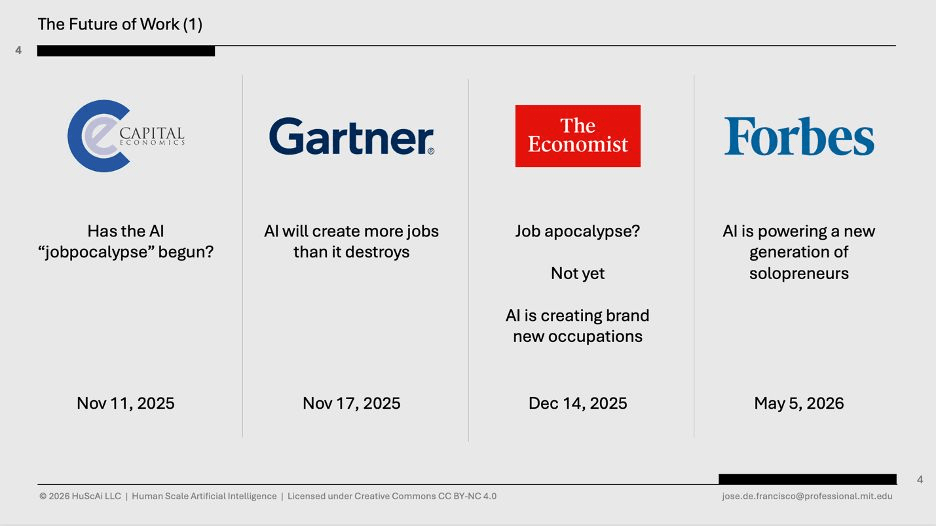
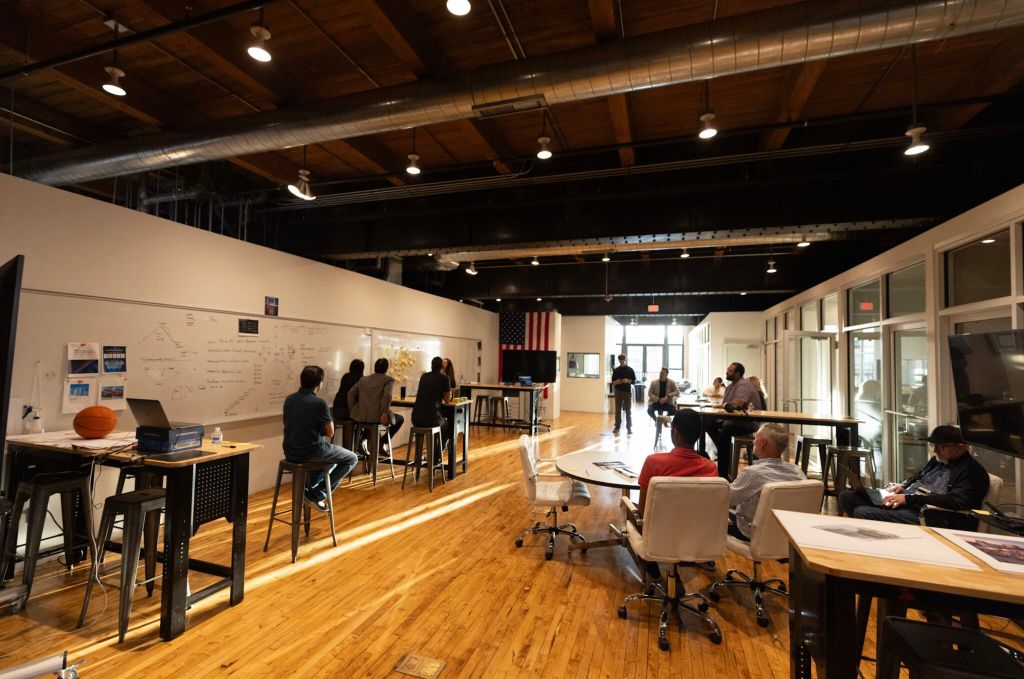
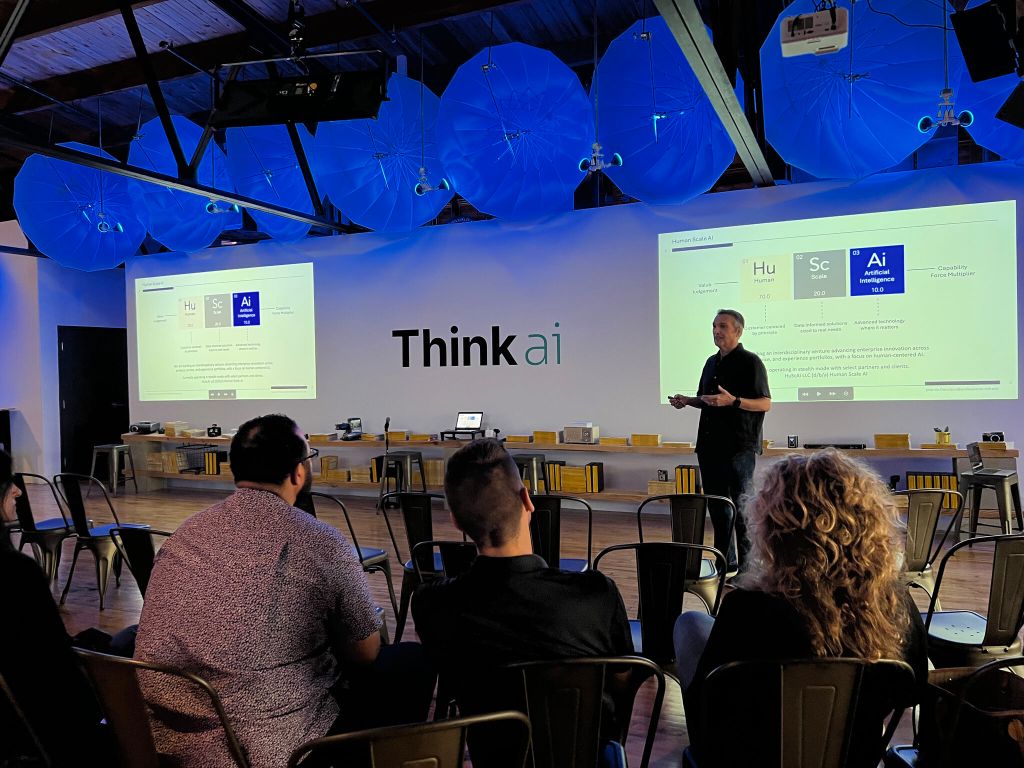
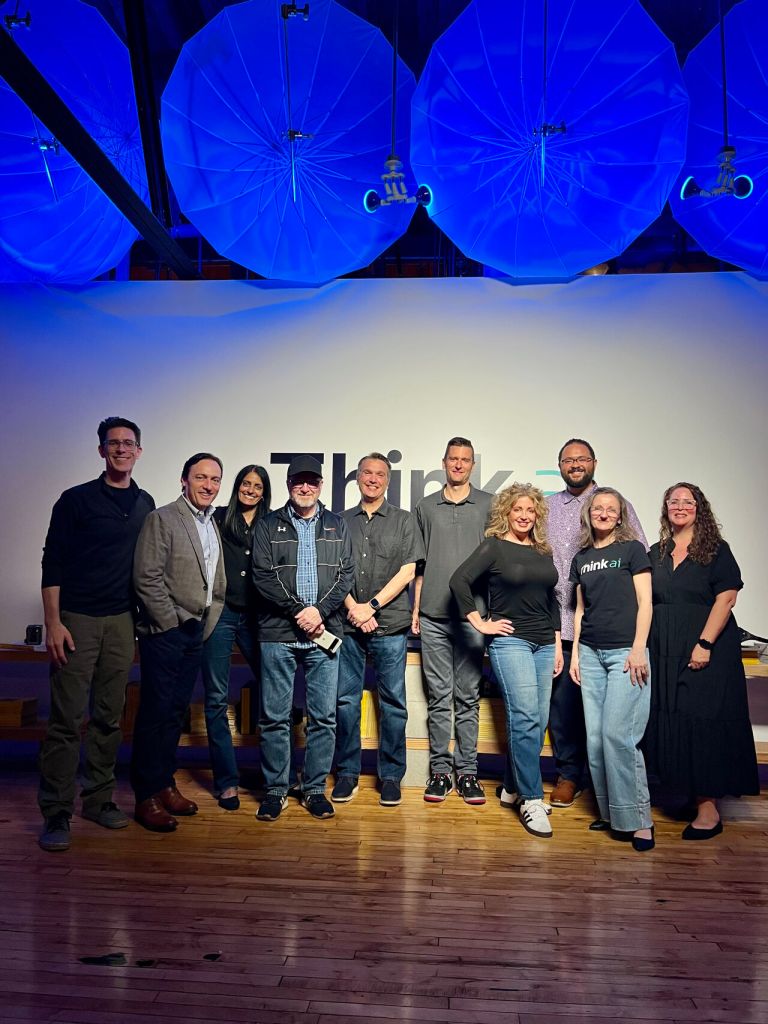
Image credit: Jimi Allen, ThinkAI founder

Leave a comment