Critical thinking meets interdisciplinary ingenuity in the AI era
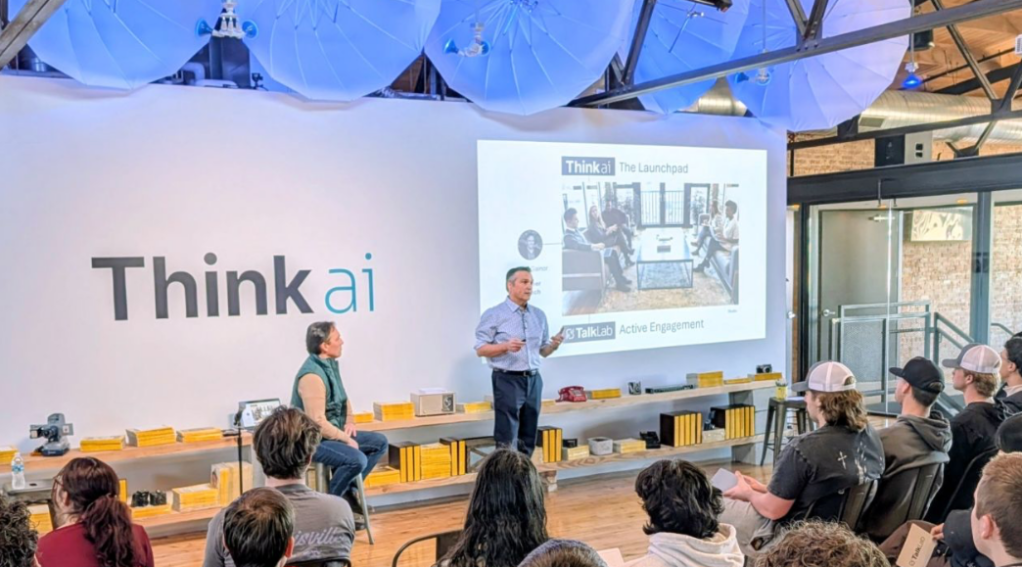
This piece shares insights from recent discussions on learning and work, drawing from lived academic and industry experiences as AI becomes increasingly capable.
WHY THIS TIME THINGS FEEL DIFFERENT
Dramatic tensions and more questions than answers, are increasingly shaping today’s discussions about the future of work. Anxiety is reported to be commonplace across sectors, industries, and generations alike. The future seems to be arriving fast, and many feel they are being put to the test before having the chance to fully learn the lesson. These themes have consistently surfaced in recent discussions with educators and students since the turn of the year.
What feels different now is a renewed sense of urgency driven by a shift toward short‑term, real‑world implications rather than distant speculation with ample time to prepare. As timelines compress and a succession of game‑changing events accelerates, the impact of AI is being felt broadly—from the youngest learners to the most experienced professionals.
MORE HUMAN
For decades, key advances in AI have been predicated on studying and seeking to emulate human cognitive processes, biological mechanisms, abilities, and behaviors. In turn, as AI becomes more capable, the need to highlight what it means to be human and what fundamentally differentiates us from successive waves of increasingly capable machines, all the way to artificial general intelligence (AGI), grows more pressing.
Clarity regarding what any AI system can and cannot do at a given time, whom it serves, for what purpose, and within which context and value system, is paramount. Disruptive systems continue to unlock new efficiencies and capabilities, placing the merits and drawbacks of creative destruction and the notion of beneficial progress under closer scrutiny. At the same time, a reality check reveals that many organizations racing to leverage AI are struggling to shift gears, as a more gradual, human‑centered transformation of culture and ways of working can deliver more sustainable results.
“The difference isn’t superior technology (…) companies achieving results balance automation for routine work with augmentation for complex tasks that require human judgment. They treat AI as a team member rather than just a tool, assigning clear roles and aligning interaction styles with how people naturally work.” Why Your AI Sits Unused, Wharton AI Insights & Analytics.
WHEN TECH PROWESS ALONE DOES NO LONGER SUFFICE
In today’s context, these are the themes I see emerging in full force in discussions with educators and students. These are also fundamentals I look for when interviewing candidates as an employer.
1. Skillset — Going beyond domain and functional expertise
- Conventional job descriptions are becoming blurred, making it essential to rethink professional development.
- Technical knowledge is now coupled with proven experiential learning, portfolios, and professional networks.
- Rapidly evolving AI literacy demands are paired with the ability to retain human agency and ownership.
- Interdisciplinary abilities blend hard and soft skills, reinforcing one another through feedback loops.
- Improving reasoning entails not only Socratic prompting but also crafting prototypes and providing samples to elicit stronger responses than conceptual framing and natural language alone can afford.
- A lifelong commitment to upskilling, reskilling, and pivoting is required amid mounting ambiguity.
2. Mindset — Curiosity and independent critical thinking
- The distance between entry‑level tasks and competence is increasingly compressed with AI tools.
- Every AI output should be treated as a hypothesis that requires questioning assumptions and asking why.
- Navigating challenges, noise, and misinformation requires an inquisitive and enduring growth mindset, which intensifies the nature of work.
- Conditional optimism relies on active discovery, informing mental models and guiding vision.
- Under uncertainty, non‑linear trajectories can explore more effectively and succeed sooner than straight paths. Cutting corners now carries greater risk.
- Unforeseen opportunities can be met through proactive preparedness as a deliberate practice supported by AI simulations.
- Entrepreneurial resourcefulness is needed more than ever to anticipate and equip both current and emerging opportunities.
3. Depth — The courage to tackle simple and wicked problems
- Undertaking what was once assumed impossible remains a continuous source of innovation with AI.
- Creative problem solving depends on the ability to deconstruct and compose, expand and contract.
- Analytical insight requires demonstrable qualitative and quantitative evidence to make progress sooner rather than later, or too late for that matter.
- Coherent understanding emerges from synthesizing hypotheses, priorities, abstractions, and explanations.
- Building networks that connect knowledge, know‑how, and experience is how collective intelligence is cultivated.
4. Leadership — Traveling the distance by leading and serving
- Leveraging online tools and AI is now the norm, while real‑life, in‑person connections build rapport.
- Identifying shared values, removing barriers, and closing gaps are core success factors for change agents.
- Client‑centric, value‑driven, data‑informed, and outcome‑oriented actions remain instrumental.
- Getting things done still requires presence, facilitation, resource management, and orchestration capabilities.
- Rebalancing directed and self‑driven work involves a mix of responsive and proactive actions.
- Timely and insightful communication goes hand in hand with listening and participatory skills.
- Going wide to align, partner, and co‑create across functions is how collective intelligence is strengthened.
These are not necessarily new ideas for many of us. What has changed is that they are no longer confined to a particular specialty, line of work, or level of seniority; instead, they have become widespread considerations when engaging with AI and team up with others to make things happen.
While attempting to address all of the above can be a tall order, the preceding outline is intended to function as an à la carte menu and guiding compass rather than an all‑or‑nothing checklist. This is not second nature to most of us. It requires leaders, educators, coaches, peer support, and policymakers working together to shape sound workforce development for this moment in time. Often, teams composed of individuals with complementary skills—rather than a single individual acting alone—can deliver greater collective value, a key insight discussed during VAI’s Inaugural Salon at Benedictine University earlier this year.
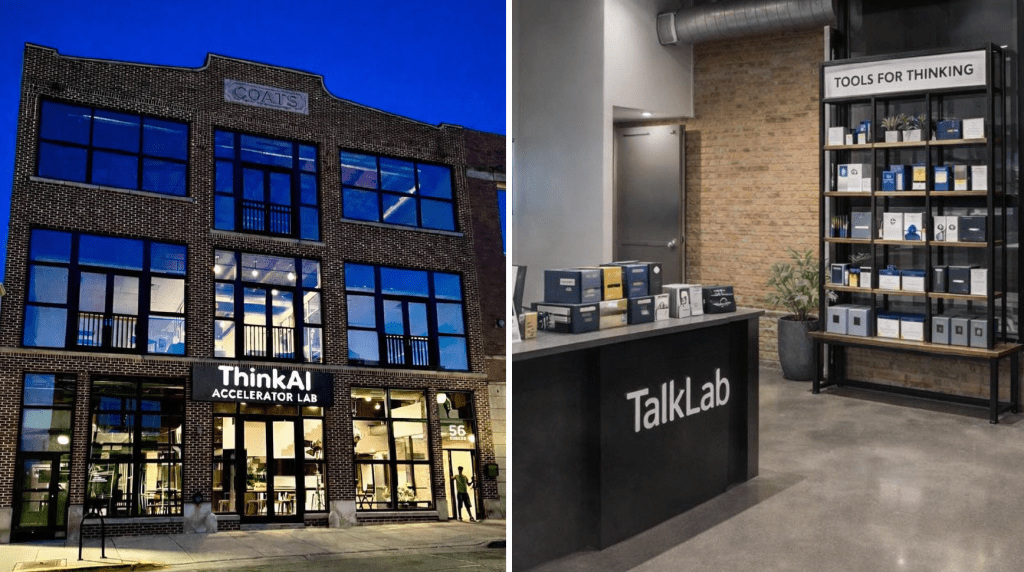
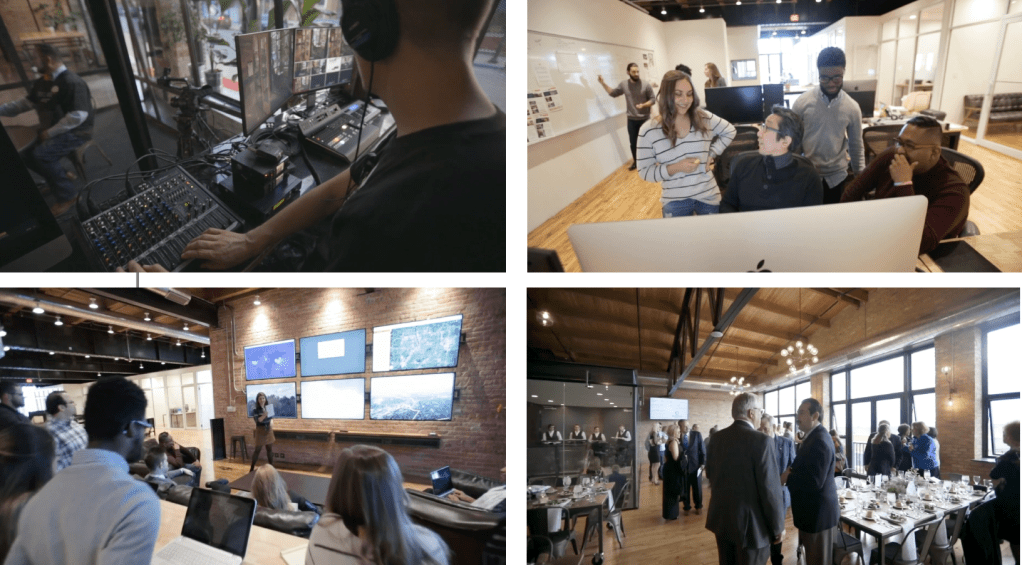
I would like to take this opportunity to share how much I appreciated the AI discussion and follow‑up conversations with Aurora University’s Entrepreneurship and Innovation Management students at Thinkai. The studio environment is purposefully architected to support a curious mindset and serves as a catalyst for exploring and seizing new possibilities. Several insights stood out:
“Innovation starts with better questions. A key theme was language. AI becomes powerful when paired with better questions and real curiosity.”
Brandon Lyon, Adjunct Professor, Entrepreneurship, Aurora University
“Thinkai is a human‑first learning lab where curiosity meets practical application. It is designed for practice over theory—moving from hype to real‑world application through shared discovery.”
Jimi Allen, TalkLab and Thinkai Founder
“A big shift in this AI era is the growing recognition of how powerful the connections are between our thinking, our conversations, and our actions.”
Ryan Gainor, TalkLab CRO and Summa Factor CEO
HUMAN SCALE AI
What worked well in the past is no longer a guaranteed recipe for success, and there is no proper insurance for what comes next. Moreover, more often than not, what makes innovators successful differs from what was initially conceived, as the journey itself helps shape a clearer sense of direction. Yet even as technologies evolve rapidly, foundational principles rooted in our shared human scale remain constant.
Educators are increasingly concerned about the outsourcing of human thinking through the transfer of reasoning, problem solving, and judgment to AI systems. Maladaptive cognitive offloading, compounded by undue influences, can degrade learning and weaken both individual and societal competence. Accepting answers without verification, along with pseudo‑logical fallacies and a self‑defeating illusion of understanding, are recurring issues of concern.
A Human Scale AI (HS AI) antidote lies in infusing personalized germane cognitive loads devoted to meaningful learning grounded in sensemaking and reasoning. HS AI supports reflective work that builds active understanding and coherent mental models, rather than defaulting to passive consumption or overwhelming extraneous complexity. Properly designed, AI can function as a partner that reinforces human agency.
Drawing from conversations with students and educators, as well as decades of academic and industry experience, I continue to advocate for the value of independent critical thinking and interdisciplinary ingenuity as AI systems grow more capable. It is clear that we need to continue the broader conversation about what it means to learn, teach, and work at human scale in the age of AI.
REFERENCES
Why Your AI Sits Unused. AI‑generated article. AI & Analytics Insights, Wharton, April 6, 2026.
Mollick, Ethan. The IT Department: Where AI Goes to Die. The Economist, April 1, 2026.
National Academies of Sciences, Engineering, and Medicine (NASEM). The Impact of Artificial Intelligence on Education and Workshop Trajectories in Tech. March 30. 2026.
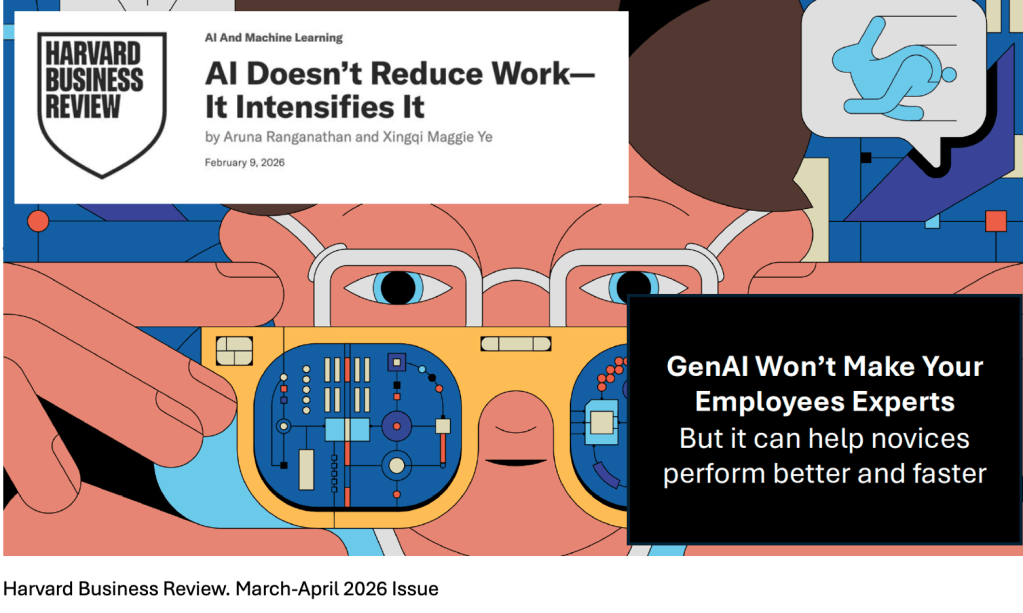
GenAI Won’t Make Your Employees Experts. Harvard Business Review, March–April 2026.
The Perils of Using AI to Replace Entry-Level Jobs. Harvard Business Review, March–April 2026.
Responsible AI Collaborative (RAIC). The AI Incident Database. Accessed April 7, 2026.
SOCIAL MEDIA COPY
Because of AI, we’re coming to terms with what competence really means.
I’ve been encouraged by what I’ve been hearing lately in conversations with educators, students, policy makers and industry professionals: we’re not just adapting to AI, we’re rethinking how learning, judgment, and agency are shaped.
This piece is one of the outcomes of those discussions on learning and workforce development as AI becomes increasingly capable, and why human scale matters more than ever.
Inside, I explore:
- Why this moment with AI feels genuinely different
- How cognitive offloading can quietly erode learning
- Why accepting answers isn’t the same as understanding
- How Skillset • Mindset • Depth • Leadership form a practical, human‑centered compass
👉 Read the full article here: [link to blog post]
#HumanScaleAI #HumanCenteredAI #FutureOfWork #AIinEducation #HumanCenteredDesign #CriticalThinking #Learning #Leadership #ThinkAI

Leave a comment