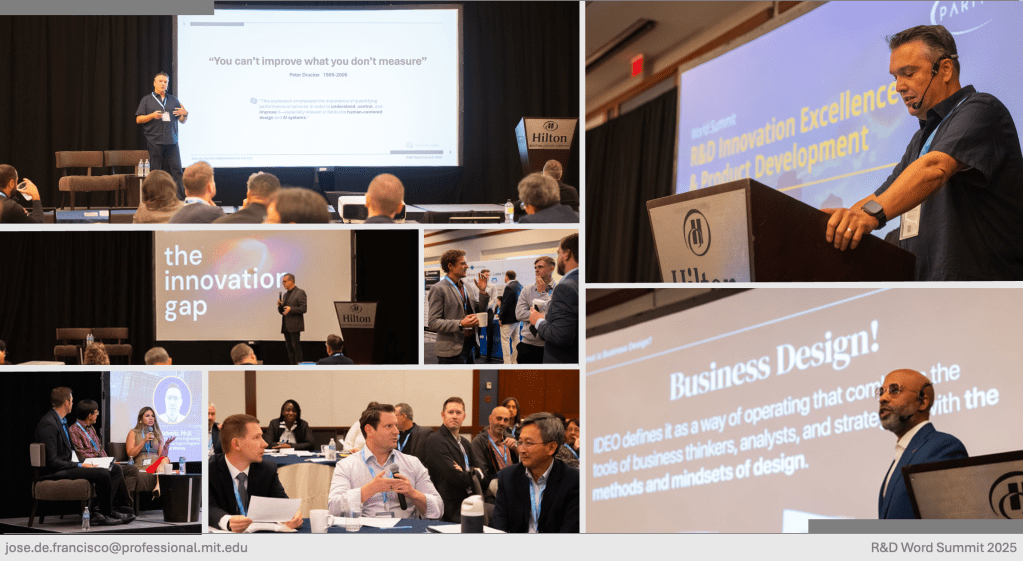
This year marked the 10th annual R&D World Summit—a milestone event that brought together technology executives from leading brands across hardtech, digital, and biotech from a wide variety of market sectors. As a returning chair for the fourth consecutive year, I was honored to deliver the opening keynote and help set the tone for a gathering focused on real-world innovation and operational excellence.
The summit is unique in its emphasis on applied product innovation, drawing active practitioners who are deeply engaged in formulating and translating advanced technologies into tangible business solutions. Our discussions spanned the challenges and opportunities facing organizations as we navigate today’s fast evolving R&D landscape.
In my keynote, I shared insights from a project initiated during my time in MIT’s CTO program, which has since evolved through my recent participation in Stanford University’s Advanced AI Leadership program. My professional perspective on the critical role of what I call Human Scale AI is devoted to modeling advanced technologies to serve users while reflecting on the essence of what makes us human.
Human Scale AI is not just about technical advancement; it’s about designing intelligent systems that are intuitive, accessible, and responsive to our human possibilities. This year, I highlighted how integrating deep user understanding as part of feedback-driven, self-evolving frameworks can accelerate the development of sound AI solutions that adapt to diverse contexts and user requirements. By leveraging interdisciplinary research and continuous iteration with test-oriented progressive prototyping we can create dynamic systems that are not only capable and outcome-driven but, most importantly, user-value-centric.
A number of our conversations reinforced the importance of interdisciplinary skills and collaboration across domains. Whether in healthcare, education, or industrial innovation, the ability to rapidly prototype, test, and refine intelligent systems is becoming a key differentiator to set new standards to lead with. The future of R&D lies in our capacity to bridge technical expertise with human-centered design, ensuring that AI and any other emerging technologies sustain, amplify, and augment human creativity and our role as ultimate decision makers.
I look forward to continue our discussions and meeting again next year in Boston.

Leave a comment