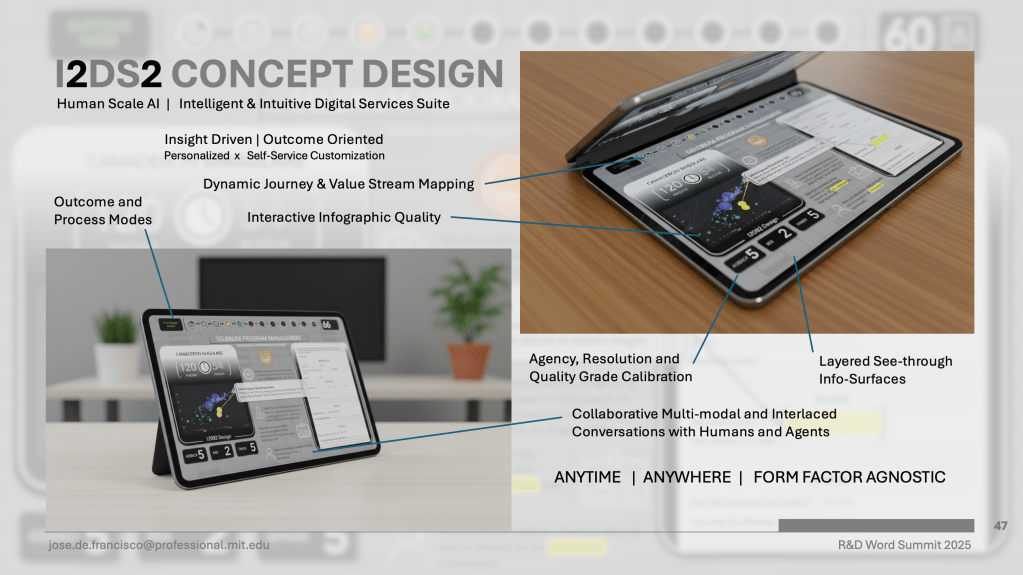
Welcome to People-First HS AI, Human Scale Artificial Intelligence.
Last month I was trusted with delivering the opening keynote at the 10th edition of the annual R&D World Summit in Boston, where I took the chance to introduce Human Scale AI as a construct to work with. I am glad and humbled to share that my session was very well received,
AI continues to scale in abstraction and boundaryless complexity beyond human grasp. It is in our best interest to redouble design efforts ensuring that it evolves to serve us at our individual and collective scale.
This blog is part of my journey as I prepare for a PhD by Portfolio, and can serve as a platform to articulate my concept of Human Scale AI.
What is Human Scale AI?
Human Scale AI is not just a technical framework—it is a professional stance with a distinctive worldview. AI should be conceived as human-centered and outcome-oriented from the outset. This means designing systems that are not merely efficient or intelligent enough, but also relevant, contextual, adaptive, assistive and responsive to user values and possibilities.
The term “Human Scale” draws inspiration from Henry Dreyfuss’s seminal work Designing for People (1955), which emphasized designing products and systems that align with human physical and cognitive capabilities. Dreyfuss’s anthropometric approach to industrial design laid the groundwork for ergonomics and human factors engineering.
In The Sciences of the Artificial (1969), Herbert A. Simon laid foundational ideas that would later influence what we now call Design Thinking and Human Centered Design. Simon argued that design is not merely a craft or aesthetic endeavor, but a distinct intellectual activity—“the science of the artificial”—focused on purposely devising artifacts to meet human purposes.
Why Human Scale Matters Now
As AI systems become more pervasive their impact on human agency, trust, and wellbeing grows exponentially at unprecedented speed. Yet, many physical and digital artifacts and systems are still designed with an obsolete machine-first mindset, optimizing for performance metrics that overlook the nuances and dynamic nature of our individual and collective human experience. Human Scale AI calls for deeper understanding of human culture, cognition, emotion and behavior in context. This requires data informing the sort of thoughtful design that expands our possibilities while respecting privacy, autonomy, and dignity.
Research’s Lens
This blog will explore Human Scale AI through a scholarly lens while reflecting on my own applied work and research portfolio over the past three decades. As I prepare for a PhD by Portfolio submission, posts and conversations will seek to address How can technology better serve and meet us at a human scale? Thank you for joining me on this journey.

Leave a comment